What Consistent Mosquito and Tick Service Actually Looks Like Over a Full Season
The Big Takeaways:
- Mosquitoes and ticks don’t follow the same seasonal schedule. Effective outdoor pest control service accounts for both life cycles separately, with treatments timed to when each pest is most active and most vulnerable.
- A single treatment doesn’t hold all season. Mosquito populations rebuild every few weeks as new adults emerge, and tick pressure has two distinct peaks. Consistent service maintains pressure on both throughout the season rather than responding after activity rebounds.
- Effective treatment comes down to interval and timing. Properties that stay ahead of the breeding cycle experience significantly less pressure than those treated reactively.
Homeowners often think about mosquito and tick control as a single category of outdoor pest management. From a scheduling and treatment standpoint, they are two separate problems that happen to share a season.
Mosquitoes are warm-weather insects whose populations build continuously from late spring through late summer. A female mosquito can lay eggs every few days under the right conditions, and those eggs can develop into biting adults in as little as four to seven days in warm temperatures. That reproductive rate is why populations rebound quickly between treatments and why interval matters as much as product selection.
Ticks operate on a two to three-year lifecycle, with each life stage most active during different stretches of the year. Temperature, more than the calendar, drives that activity: ticks can quest once conditions climb above roughly 40°F, and, in much of our service area, that means there is no true off-season. According to the University of Connecticut, deer tick adults tend to be most active in spring and late fall, while nymphs peak in late spring through summer, and larvae follow in late summer. All three stages are hard to spot during a tick check, since they favor hard-to-inspect areas of the body, which is part of why year-round tick prevention, for pets as well as people, matters. That staggered pattern means tick pressure doesn’t arrive all at once or fade after a single treatment pass.
Managing both pests effectively through a full season requires a program that accounts for those separate timelines rather than treating them as a single event.
The Seasonal Timeline of a Mosquito and Tick Control Program
A well-structured outdoor pest control program doesn’t start when activity becomes noticeable. It starts before populations establish, which is what allows treatments to interrupt the seasonal cycle rather than chase it.
| Month | Mosquito Pressure | Tick Pressure | Treatment Focus |
| March to April | Low to building. Overwintering females become active as temperatures rise above 50°F | Moderate. Adult deer ticks reach spring activity peak before nymphs emerge | First treatment targets overwintering mosquito populations and adult tick activity before nymph season begins |
| May to June | Moderate to high. Populations build rapidly as temperatures warm and standing water from spring rain creates breeding conditions | High. Nymphal deer ticks reach peak activity; highest disease transmission risk of the year | Regular mosquito treatments at 21 to 30 day intervals; tick treatment timed to nymph peak |
| July to August | Peak. Hot temperatures and humidity support continuous mosquito breeding; pressure is highest near shaded, moist areas | Moderate. Nymph activity tapers; larval stage active in late summer | Continued mosquito treatment intervals; tick monitoring for late-summer larval activity |
| September to October | Declining but active. Cooler temperatures slow breeding, but mosquitoes remain active until first frost | Moderate to high. Adult deer ticks become active again; second seasonal peak | Final mosquito treatments as season closes; tick treatment timed to fall adult activity peak |
| November | Low. Frost stops mosquito activity | Moderate. Adult tick activity continues on warm days until temperatures drop consistently below freezing | Season close; evaluation of property conditions heading into next year |
Cold weather slows both pests down, but it doesn’t stop risk entirely. Several mosquito species overwinter as eggs and resume activity as soon as conditions allow, and nymphal ticks have been found active even on snow during the coldest months. Hunters, hikers, and anyone spending extended time outdoors in winter remain exposed to tick bites and the pathogens they carry, even in months when a treatment program isn’t actively running.
Where Mosquitoes and Ticks Are Most Active on Your Property
Understanding where each pest concentrates on a given property is what separates a treatment that holds from one that fades within a week. Applying product in the wrong areas, regardless of timing, produces limited results.
Mosquitoes aren’t strictly nighttime pests. Asian tiger mosquitoes, common throughout our service area, are active during the day, with peak biting activity in the early morning and late afternoon, right when people are leaving for work or coming home. They’ll also breed indoors in standing water like aquariums or flower vases, and wait near entrances and doorways for a host to pass by. Outdoors, mosquitoes rest in shaded, humid vegetation between feeding cycles: dense shrubs and ground cover, tall grass, the understory of mature trees, the space under sun decks, and around exterior staircases leading down to basements. Mosquito breeding sites on residential properties are often smaller and more numerous than homeowners expect. A bottle cap holds enough water for mosquitoes to breed, so gutters, low spots in the yard, and containers left outdoors all count. Humidity across the DMV makes this harder to manage than in drier climates, since moisture that would evaporate elsewhere tends to stick around here.
Ticks concentrate in the transition zones between maintained lawn and taller vegetation, wooded edges, and areas where wildlife travel corridors cross the property. According to the CDC, ticks are most commonly encountered in wooded or brushy areas with leaf litter and in areas with high grass and low shrubs, but exposure on a property doesn’t require deer or other large animals nearby. Raccoons, deer mice, squirrels, and birds nesting in an attic or basement often carry their own population of ticks and other ectoparasites, and can introduce them directly onto the property and onto pets. Free-roaming cats are especially exposed to this kind of transfer and typically need tick prophylaxis of their own. The edge where a mowed lawn meets an unmaintained border is where backyard tick control efforts should be concentrated, not the interior of an open lawn where ticks rarely quest.
What Each Service Visit in a Mosquito and Tick Control Program Actually Does
A professional service visit is not a single application across the whole yard. It targets the specific environments where each pest is active based on the time of season, property conditions, and what was found during the prior visit.
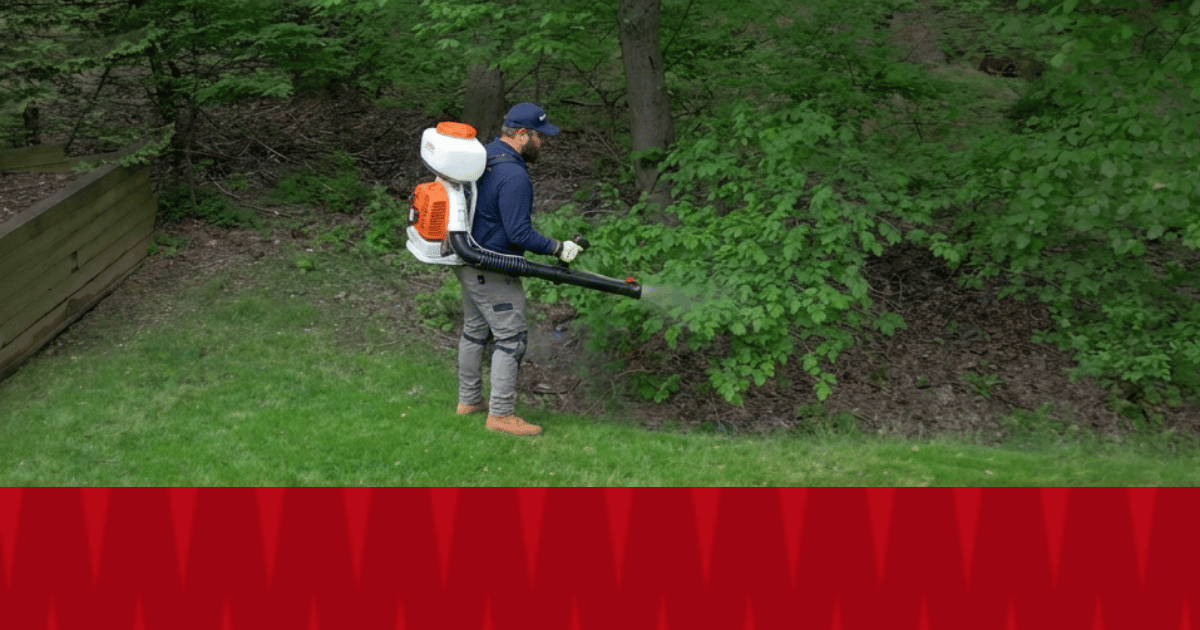
For mosquitoes, treatment focuses on the resting and breeding habitat: the foliage, shaded understory, and any standing water sources identified during the visit. Barrier treatments applied to vegetation provide residual protection that holds for three to four weeks under normal conditions. Sunlight is a major factor in that breakdown. UV exposure degrades the active ingredient in most barrier treatments, and studies on these formulations have shown meaningful breakdown within two to three weeks of direct sun exposure alone. Rain, humidity, and general moisture accelerate that breakdown further.
Heat, heavy rain, and new adult emergence from untreated breeding sources all affect how long that window holds, which is why professional mosquito control programs are scheduled at 21 to 30 day intervals through peak season rather than on a single treatment basis.
For ticks, treatment targets the perimeter of the property and the vegetation in transition zones where ticks quest for hosts. A full-season tick control program timed to the two activity peaks, spring nymphs and fall adults, addresses the life stages that present the most exposure risk rather than treating uniformly throughout the year.
Why Single Treatments Fall Short
A homeowner who schedules a single mosquito and tick visit in early summer has addressed one window of the season, not the season itself. Both pests rebuild pressure continuously and from multiple sources. Mosquito populations rebound from nearby breeding sites within two to three weeks. Tick populations moving from adjacent wooded areas or carried onto the property by wildlife don’t stop at the property line.
Because both pests are active across overlapping stretches of the year, treatment is scheduled as a combined program rather than as separate mosquito and tick visits. That approach also allows more flexibility around timing, since a visit can be scheduled or adjusted around the conditions that actually affect how well a treatment holds, dry spells, wind, and upcoming rain, rather than locking into a fixed date regardless of weather.
Properties that experience the most sustained relief from mosquito and tick pressure are those on consistent treatment intervals that match the biology of each pest. A complete guide to mosquito prevention covers the full range of conditions that drive pressure and how professional treatment fits into a broader prevention strategy.
What Property Conditions Affect How Well Treatments Hold
No two properties hold a treatment the same way. Conditions that affect how long a mosquito or tick treatment remains effective include:
- Shade and canopy coverage: Dense tree canopy keeps vegetation below humid and cool, extending mosquito resting habitat and reducing how quickly treatments break down in direct sun
- Standing water sources: Properties with chronic standing water, whether from drainage issues, gutters, or containers, continuously produce new mosquitoes regardless of how well a barrier treatment was applied
- Proximity to wooded areas or green spaces: Lots that border trails, parks, or wooded corridors experience continuous tick immigration from adjacent habitat, requiring tighter treatment intervals to maintain protection
- Lawn and vegetation management: Overgrown ground cover, unmaintained borders, and leaf litter accumulation all extend the habitat available to both pests between service visits
- Rainfall, direct sun, and temperature: Heavy rain, humidity, and direct UV exposure all break down barrier treatments faster than expected, while heat accelerates mosquito development and shortens the window between treatments. Formulations built to resist this breakdown, such as microencapsulated or granular products, can extend how long a treatment holds in exposed or high-moisture areas.
A Mosquito and Tick Control Program That Fits Your Property
American Pest offers mosquito and tick control services designed around your property’s specific conditions, rather than a fixed calendar. Weather patterns have become less predictable year to year, so a program built around actual temperature and moisture conditions holds up better than one built around the month on a calendar. A program scheduled from early spring through fall addresses both pests during active windows rather than waiting until pressure becomes noticeable. Warm stretches in the off-season can also bring out other pests worth a look. So a visit scheduled for mosquitoes and ticks is a good opportunity to flag anything else showing up around the home like stinging insects or other seasonal pest pressures.
For homeowners who want to understand what professional mosquito treatment looks like on the ground before scheduling service, that breakdown covers what a technician actually does during each visit and what to expect in the days that follow.
Contact American Pest to schedule a property assessment and build a treatment program before the season gets ahead of you.
Related Posts
Contact Us Today!
Do you need an estimate for service or have questions about pests? We’d love to hear from you!
Fill out the form and receive feedback today. For immediate service, please give us a call!