What Causes Clover Mite Infestations Around Your Home
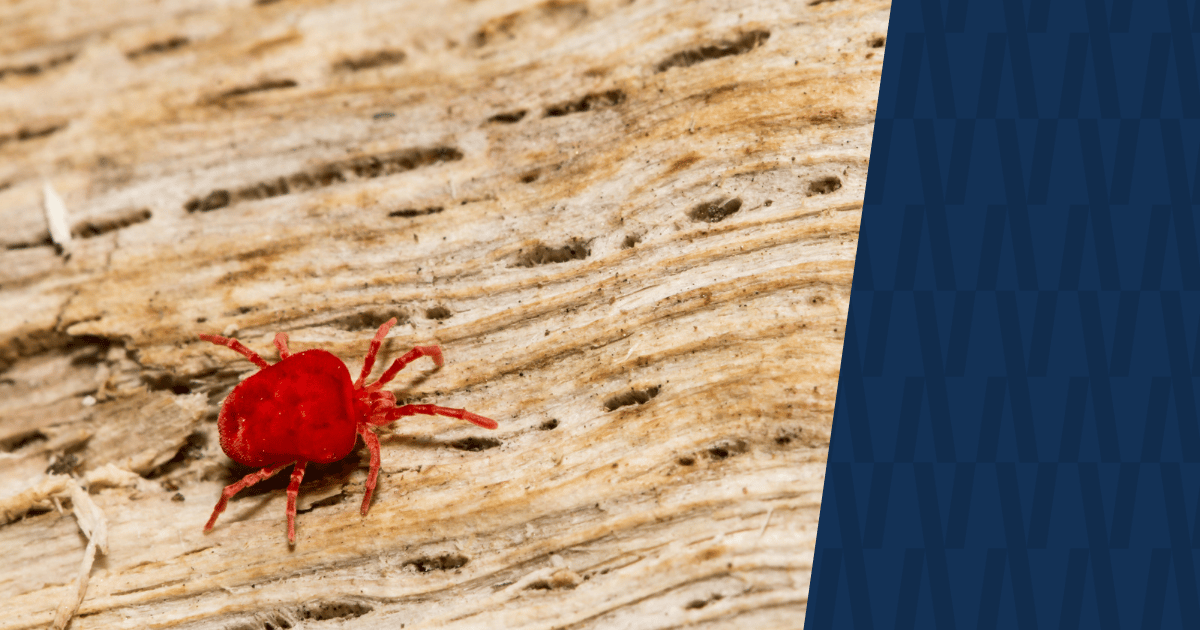
Table of Contents
The Big Takeaways:
- Overfertilized lawns, moss, and consistently damp spots around a structure (roofs, pavers, leaf litter) are what typically drive large clover mite populations, not dry weather.
- Clover mites are most active from roughly April through late June, and again in fall once temperatures return to the 50°F to 75°F range. Past about 90°F, unsheltered mites dry out and die, while others settle into a heat-driven dormancy in moist, protected spots, not into homes.
- Clover mites don’t bite, don’t reproduce indoors, and rarely survive more than a few days inside. Squishing one leaves a faint mark, not a lasting stain, so a vacuum or damp cloth handles them without much fuss.
What Are These Tiny Red Bugs?
Finding small red specks along windowsills, baseboards, or walls is enough to make most homeowners start searching for answers. In most cases, those specks are clover mites, a plant-feeding arachnid that has little interest in the inside of a house and no ability to survive there for long.
Clover mites are roughly 1/32 of an inch long, reddish-brown, and identifiable by an unusually long front pair of legs that’s often mistaken for antennae. They aren’t insects. They’re mites, related to spiders and ticks, and they feed exclusively on plant material. According to the University of Kentucky, clover mites don’t bite, don’t feed on blood, and won’t reproduce indoors. Once inside, they typically die within a few days from dehydration, the same vulnerability to moisture loss that shapes most of their behavior outdoors.
Clover mites move in groups, and, because they crawl rather than fly, the usual encounter is stepping on or squishing one rather than swatting it. That can leave a faint reddish-brown mark from the mite’s body pigment on windowsills, curtains, or furniture. It’s a minor cosmetic issue rather than a lasting stain, and a vacuum with a crevice attachment, or a damp cloth, clears them without leaving a mark at all.
When Clover Mites Are Actually Active
Clover mites are outdoor pests almost all of the time, and their activity follows temperature and moisture rather than the calendar. Understanding that pattern helps separate normal outdoor activity from an actual indoor problem.
| Period | What’s Happening Outdoors | What It Means for Your Home |
| April to June (spring into early summer) | Peak activity: feeding, egg-laying, and population growth, especially on lush, well-watered, overfertilized lawns | Most indoor sightings happen here, as large outdoor populations look for entry points near the foundation |
| Once temps pass about 90°F | Mites without shelter dry out and die quickly, since their small size means they lose moisture fast; the rest go into aestivation, a heat-driven dormancy, tucked into moist, protected spots like leaf litter, mulch, or under pavers | Not a trigger for indoor movement; surviving mites are hunkered down outside, waiting for cooler weather |
| September to November (fall) | Temperatures drop back into the 50°F to 75°F range clover mites prefer, and activity picks back up in a pattern similar to spring | A second wave of outdoor activity, and often a second round of sightings near windows and foundations |
| Winter | Mostly dormant; eggs overwinter in cracks and crevices on exterior walls | Little to no activity |
According to Penn State, clover mites are most active between 50°F and 75°F and typically complete only one generation before their summer dormancy sets in. That dormancy, called aestivation, doesn’t mean the mites are heading indoors. It’s a survival response to heat: mites tuck into moist, sheltered outdoor locations, wait out the hot months, then resume activity once temperatures cool back into their preferred range in fall.
What Actually Drives a Clover Mite Infestation
Most clover mite infestations trace back to conditions that keep the area right around a structure consistently lush, damp, or covered in organic debris. Heat and dry weather aren’t what push them inside.
According to NC State University, mite invasions are most common around vigorously growing lawns and other vegetation, particularly where shrubs are close to or touching exterior walls. Overfertilized lawns are one of the biggest contributors; heavy fertilization produces the dense, moisture-rich grass that supports far larger outdoor populations than a sparse, moderately watered lawn.
Moisture matters just as much as vegetation. Clover mites feed on the chlorophyll in moss, so moss growing on foundation walls, roofs, or pavers due to persistent dampness gives them another food source right at the building’s edge. On commercial properties, this shows up in a few specific ways: skylights that aren’t properly sealed, rooftop areas or tarps that hold water, and pavers or low spots where moisture collects and moss takes hold. Leaf litter and other organic debris that builds up near the foundation, in gutters, or on a roof creates the same kind of damp, sheltered pocket where mites develop.
Conditions that raise the odds of a clover mite problem:
- Grass, moss, or other ground cover growing against or touching foundation walls, with no bare zone between vegetation and the structure
- Moss on foundation walls, roofs, or pavers from persistent moisture, which clover mites feed on directly
- Heavy lawn fertilization, which produces the dense, moisture-rich grass that supports the largest outdoor populations (and can also send fertilizer runoff into nearby waterways)
- Leaf litter or organic debris collecting near the foundation, in gutters, on roofs, or under pavers, creating damp pockets where mites develop
- On commercial buildings, unsealed skylights or roof areas that hold moisture, which double as entry points and food sources
- Cracks or gaps in foundation caulking, window frames, door thresholds, weep holes, or utility penetrations, which mites climb onto from the outside masonry.
How to Tell If It’s a Clover Mite and Not Something Else
Not every tiny red bug is a clover mite. A few species are commonly confused with them, and correct identification matters before taking any control steps.
Clover mites are distinguished from similar-looking pests by their very long front legs, which extend noticeably beyond the body and create the appearance of antennae. They are plant feeders found near windows and exterior walls, not in food storage areas, bedding, or on people or pets. Comparing them to the most commonly confused species:
- Chiggers are also tiny and red but are found outdoors in vegetation and bite humans. Clover mites do not bite.
- Spider mites are similar in size but found on indoor or outdoor plants, leaving stippled damage on leaves. Clover mites crawl on surfaces rather than staying on plants.
- Concrete mites in the genus Balaustium are also red and found on exterior surfaces in spring, but feed on pollen rather than grass and clover.
- Straw itch mites bite and are associated with stored grain or hay, not lawn vegetation.
If the red bugs appear near windows and exterior walls, move in large numbers, and leave a faint reddish mark when crushed, clover mites are the most likely identification, a distinction the University of Florida IFAS Extension also walks through in detail. For a broader look at tiny red bugs that appear indoors, several species follow similar seasonal patterns.
Clover Mite Prevention and Professional Control
Because clover mites don’t reproduce indoors and die within days without plant material to feed on, an ongoing indoor presence almost always points to a large outdoor population right next to the structure. Addressing the conditions outside makes the biggest difference, and once a property has real activity, American Pest is equipped to handle the rest.
Start with the perimeter. According to the University of Connecticut, an unplanted strip of sand or fine gravel 18 to 24 inches wide around the foundation significantly cuts down on the number of mites getting inside, since clover mites avoid crossing dry, bare surfaces. That same principle extends to moisture and moss: keeping foundation walls, roofs, and pavers free of moss, and correcting the damp spots that let it grow, removes another food source drawing mites toward the building.
Conditions worth addressing around a property, especially heading into spring and again in fall:
- Maintain a vegetation-free zone of at least 18 inches between foundation walls and the nearest grass, ground cover, or ornamental planting
- Clear moss from foundation walls, roofs, and pavers, and correct the drainage or irrigation issues keeping those areas damp
- Remove leaf litter and organic debris from gutters, rooflines, and the base of the foundation on a regular basis
- Avoid over-fertilizing lawns near the foundation; a moderately watered, moderately fed lawn supports a much smaller outdoor population
- Seal exterior cracks around windows, doors, weep holes, and the foundation with caulk, paying attention to the sunny side of the home where mite activity concentrates
- On commercial properties, check that skylights and roof penetrations are properly sealed, and address any low spots on the roof or pavers where water collects.
A handful of mites on a windowsill is a minor nuisance, and an isolated sighting usually isn’t cause for concern. But once activity picks up or keeps recurring, that’s a sign the outdoor population near the structure has grown beyond what property upkeep alone will resolve, and it’s worth bringing in a professional rather than managing it as an ongoing routine.
That’s especially true in commercial or sensitive environments, where even a small number of mites is a problem. A pest professional can identify exactly where mites are getting in, address the conditions drawing them close to the structure, and apply an EPA-approved miticide to the perimeter when warranted, timed ahead of the spring or fall activity windows for the best results.
If you’re seeing repeated clover mite activity despite prevention efforts, or the moisture and vegetation conditions around your property are hard to fully control, contact American Pest to schedule an inspection and talk through options before the next spring or fall activity window.
Related Posts
Contact Us Today!
Do you need an estimate for service or have questions about pests? We’d love to hear from you!
Fill out the form and receive feedback today. For immediate service, please give us a call!