Bat Bugs vs. Bed Bugs
Table of Contents
The Big Takeaways
- Bat bugs and bed bugs look similar, but they have different hosts and treatment needs.
- Bat bugs feed primarily on bats; they cannot reproduce without a bat host, unlike bed bugs.
- Homeowners should avoid self-diagnosing; professional identification is crucial for effective treatment.
- Signs of bat bugs include bites and the presence of small brownish insects, especially near bat colonies.
- To eliminate bat bugs, first remove the bat colony and then treat for the bugs; professional help is recommended.
You wake up with itchy red bites. You pull back the sheets, inspect the mattress seams, and find small brownish insects you do not recognize. Your first thought is bed bugs. It is a reasonable assumption. But there is another possibility that most homeowners never consider: bat bugs.
Bat bugs and bed bugs are so similar in appearance that even experienced pest professionals sometimes need a microscope to tell them apart. The confusion is completely understandable. But knowing which one you are dealing with matters a great deal, because the source of the problem is different, the treatment approach is different, and treating the wrong pest will not solve anything.
What Is a Bat Bug?
A bat bug is a parasitic insect that feeds primarily on bats. It belongs to the same family as the bed bug and is closely related, but its preferred host is a bat rather than a human. According to Iowa State University Extension, bat bugs are found throughout North America and are most commonly associated with colonies of big brown bats and little brown bats, two species that frequently roost in residential structures.
Bat bugs enter homes the same way their preferred hosts do. When a bat colony takes up residence in an attic, chimney, wall void, or soffit, bat bugs come with them. They live near the roosting site, feeding on bats as their primary food source. The problem for homeowners starts when bats leave or are excluded from a structure. With their preferred host gone, bat bugs migrate downward through walls and ceilings in search of an alternative, and that is often when they end up in living spaces and in beds.
Unlike bed bugs, bat bugs cannot sustain themselves on human blood alone. They can bite people, but they cannot reproduce without access to bat hosts. That distinction is important for understanding both how serious the problem is and how to address it properly.
Bat Bugs vs. Bed Bugs: How to Tell Them Apart
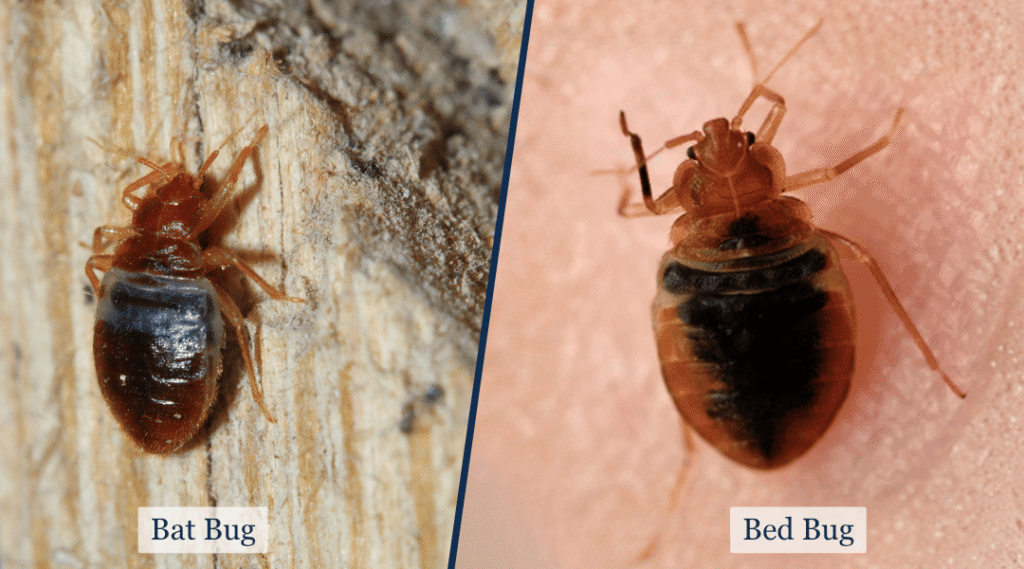
Side by side, a bat bug and a bed bug look nearly identical. Both are small, flat, and oval-shaped. Both are a similar reddish-brown color. Both are roughly the size of an apple seed. Without magnification, most people, and many pest professionals at first glance, cannot tell them apart.
The distinguishing feature is found on the pronotum, the shield-like segment just behind the head. Bat bugs have longer, more prominent fringe hairs — longer than the width of their eyes — on the pronotum compared to bed bugs. That difference is subtle enough that it typically requires a hand lens or microscope to confirm.
For homeowners, the practical takeaway is straightforward: do not try to self-diagnose. If you are finding small brownish insects in your home and are not sure whether you are looking at a bat bug vs. a bed bug, professional identification is the right first step. Treating bed bugs when the actual problem is bat bugs will not work, and vice versa.
Contact Us Today
If you have questions about our services, plans, or pricing, we are here for you. Call or fill out the form to communicate by email.
Signs of Bat Bugs in Your Home
Bat bug activity tends to show up in a specific pattern. Because bat bugs follow their hosts, the signs often start in upper areas of the home near where bats are roosting before migrating downward into living spaces. Here is what to watch for:
- A known or suspected bat colony in the attic, chimney, wall void, or under roofing materials
- Small brownish insects near roosting areas, along the tops of walls, or around ceiling fixtures
- Shed skins or dark spotting along baseboards, mattress seams, or upholstered furniture
- Unexplained bites appearing on household members with no confirmed bed bug presence
That last point deserves some attention. If you or someone in your home is waking up with bites and a thorough inspection has not turned up a bed bug infestation, bat bugs may be worth investigating, especially if there is any history of bat activity in or around the structure.
Bat Bug Bites vs. Bed Bug Bites
Bat bug bites and bed bug bites look the same on the skin. Both produce red, itchy welts that may appear in clusters or a loose line pattern. There is no reliable way to tell them apart based on the bite alone, which is another reason why proper identification of the insect itself matters.
The difference lies in what the bites mean. Bed bug bites indicate an established infestation that can grow and spread without treatment. Bat bug bites are a secondary symptom of a bat problem. Because bat bugs cannot reproduce on human blood, a bat bug population in your living space will not sustain itself the way a bed bug population would. But that does not mean the situation resolves on its own. As long as a bat colony is present in the structure, bat bugs will keep coming.
Are Bat Bugs as Bad as Bed Bugs?
The short answer is that bat bugs and bed bugs are bad in different ways.
Bed bugs are a self-sustaining infestation. They breed on human hosts, spread through a home over time, and require direct treatment to eliminate. If you have bed bugs, the infestation will not go away without intervention.
Bat bugs are not self-sustaining in the same way. Without a bat host, the population cannot reproduce, and it will eventually die off. That makes bat bugs less persistently problematic than bed bugs in terms of the insect itself. But bat bugs are a clear signal that a bat colony is present somewhere in the structure, and that poses its own set of concerns: structural damage from roosting, health risks from bat droppings, and the likelihood that bat bugs will persist as long as the bats remain.
So while bat bugs may not be as relentless as bed bugs on their own, dismissing them is a mistake. They are a symptom of a larger issue that will not resolve without professional attention.
What to Do If You Find Bat Bugs
If you suspect bat bugs in your home, the response is different from a standard pest treatment. Here is what to keep in mind:
- Do not attempt to remove bats or disturb roosting areas on your own. Bat removal is regulated under state and federal wildlife laws in most jurisdictions, and disturbing a colony incorrectly can scatter both bats and bugs further into the home.
- Do not treat for bat bugs before the bat colony has been addressed. Eliminating the bugs without removing the host will not solve the problem. Bat bugs will continue to appear as long as bats are present.
- Contact a pest control company with experience in both bat exclusion and bat bug treatment. These are two distinct services, and a company that handles both can coordinate the response properly.
- Follow up after bat exclusion to confirm that bat bugs have been fully eliminated from living spaces. Once bats are gone and the entry points are sealed, a targeted treatment for any remaining bat bugs may still be needed.
If you are seeing signs of bat bug activity in or around your home, getting the right identification early makes the rest of the process considerably more straightforward.
Related Posts
Contact Us Today!
Do you need an estimate for service or have questions about pests? We’d love to hear from you!
Fill out the form and receive feedback today. For immediate service, please give us a call!