Termite Swarmers May Be the Messengers for the Colonies Around Your House
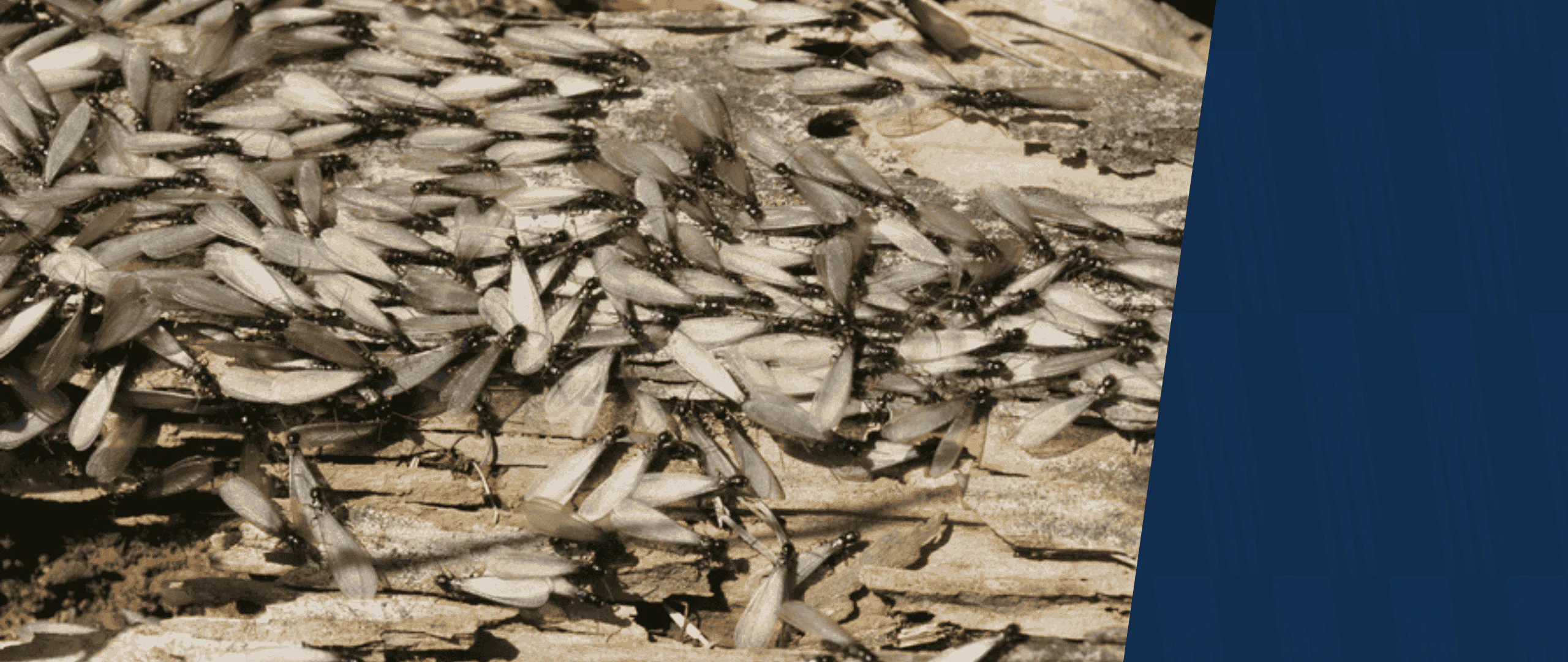
Table of Contents
The Big Takeaways
- Termite swarmers indicate nearby termite activity and signal that a mature colony is expanding.
- Swarmers do not cause damage themselves, but their presence suggests hidden damage from worker termites.
- Swarming usually occurs in spring and early summer, triggered by specific environmental conditions like moisture and temperature.
- Finding swarmers indoors means they likely emerged from a nearby or established colony, which has been causing damage for years.
- Homeowners should seek professional evaluations to identify early warning signs and prevent severe structural problems.
Every spring, homeowners may start noticing winged insects gathering near windows, crawling across windowsills, or emerging from the soil around the foundation. For many, the instinct is to sweep them up and move on. That instinct can be costly.
Termite swarmers are often the first visible sign of termite activity near a home. Known as alates or swarmers, they are the reproductive members of a mature colony whose sole purpose is to mate, spread, and establish new colonies of their own. Seeing them around your home does not mean they are actively chewing through your walls. Swarmers are not the ones causing damage. But their presence signals that a nearby colony has grown large enough over several years for the queen to begin producing alates to expand her reach. These swarmers are weak fliers that typically travel only a few hundred feet from the original colony, often landing nearby to mate and shed their wings, though favorable winds can occasionally carry them several miles away.
Understanding what termite swarmers are, why they appear, and what they mean for your home gives you a significant advantage. Termite swarm season follows a predictable pattern, and homeowners who recognize it early are better positioned to respond before the real problem gets worse.
Contact Us Today
If you have questions about our services, plans, or pricing, we are here for you. Call or fill out the form to communicate by email.
What Are Termite Swarmers and Flying Termites
A termite colony is made up of several distinct groups, each with a specific role. Workers are responsible for feeding the colony and are the ones actually consuming wood. Soldiers defend the nest. And then there are the reproductives, the alates, which are what most people refer to as termite swarmers or flying termites.
Flying termites are not a separate species. They are members of an existing colony that have developed wings during their reproductive stage. When a colony matures and conditions are right, it produces swarmers and releases them into the environment. Their jobs are to find a mate, to shed their wings, and to return to the soil to start a new colony somewhere else. Alates cannot consume wood, and, without access to moisture from the soil, they die. This is why swarmers found inside a home rarely survive for long.
What that does not mean, however, is that the situation is harmless. Swarmers inside a home are not spreading the infestation or chewing through your walls. But their presence points to a real and immediate problem. The workers behind them have likely been damaging the structure for several years, quietly feeding long before the colony grew large enough to produce swarmers at all.
This is why termites swarm: it is a natural expansion mechanism. The swarmers you see near your home emerged from somewhere, and that somewhere is likely closer than you think.
Why Termites Swarm During Termite Swarm Season
Termites do not swarm randomly. Environmental conditions trigger swarming activity, and those conditions tend to align during a fairly predictable window each year. According to University of Florida entomologists, swarming is typically triggered by rising soil temperatures, increased moisture levels, and changes in daylight — conditions that converge most reliably in spring and early summer across much of the Eastern United States.
Swarming activity typically peaks between March and May, though warm spells can push activity earlier or later depending on the year. Swarms are especially common on warm, calm days following rainfall, when humidity is high, and conditions favor flight.
What makes swarming easy to overlook is how brief it is. A swarm can last anywhere from a few minutes to a few hours. The swarmers disperse, most of them die, and the event appears to be over. But the parent colony that produced them is still active, and research from Rutgers University found that a single mature eastern subterranean termite colony can contain hundreds of thousands of workers continuing to feed long after the swarm ends.
What Swarmers in a House Usually Mean
Finding swarmers in your house is rarely a random occurrence. Swarmers are strongly attracted to light, which is why they tend to gather near windows, sliding glass doors, and light fixtures. If they are appearing inside, they almost certainly emerged from somewhere within the structure or just outside it.
Swarmers in a house often indicate hidden termite activity within wall voids, crawl spaces, or near the foundation. The colony producing those swarmers has likely been established for several years, since subterranean termite colonies typically take three to five years to mature to the point of swarming. That means, by the time you see flying termites indoors, the colony behind them has had years to develop.
One important clarification: swarmers themselves do not cause structural damage. They do not feed on wood. But dismissing them because they die off quickly misses the point entirely. Their death does not resolve the underlying issue. The parent colony remains active whether the swarmers survive or not.
| Location Found | What It May Signal | Recommended Action |
| Near windows or interior light sources | Active colony inside wall voids | Schedule a termite inspection |
| Basement or crawl space | Colony near the foundation | Professional evaluation |
| Exterior foundation or soil | Colony in soil nearby | Monitor and inspect promptly |
Termite Swarm Season and What to Expect
Termite swarm season in the Mid-Atlantic typically runs from late winter through early summer, with the heaviest activity concentrated in March, April, and May. Eastern subterranean termites, the most common species in this region, tend to swarm earlier in the season, often on sunny afternoons after a rain event.
Weather variability can shift that window. A mild February can bring early swarmers. A cold, wet spring can delay activity into June. Homeowners who see flying termites suddenly appearing in large numbers are often catching the tail end of a swarm that has already peaked, which means the window to catch it in the act is short.
Swarming itself is brief, but what it represents is not. Colony activity continues throughout the year regardless of season, and the University of Georgia notes that some termite species forage aggressively even during cooler months when feeding slows for others. Swarm season is the most visible moment in a much longer and less visible process.
Why You May See Flying Termites but No Visible Damage
One of the more confusing aspects of a termite problem is that swarmers can appear without any obvious signs of structural damage. Swarmers showing up before visible damage is not a sign that the situation is minor. It is an opportunity to act before damage becomes severe.
Termite damage develops slowly and out of sight, progressing through the interior of wood long before it becomes visible from the outside. By the time damage is apparent to a homeowner, the infestation has often been active for years.
How Professional Inspections Respond to Termite Swarmers
When a pest professional responds to a reported swarmer sighting, the inspection goes well beyond looking for live insects. The goal is to determine where the colony is, how established it is, and what conditions around the property are making activity possible.
Inspection focus areas typically include foundation walls, crawl spaces, basement framing, wood-to-soil contact points, and any area where moisture has accumulated near the structure. These are the conditions that invite termite activity in the first place, and addressing them is part of any recommendations.
It is also worth noting that swarming ants and termites are frequently confused with one another. A professional can confirm whether what you are seeing is actually a termite swarm, which affects both the urgency and the treatment approach.
A professional inspection identifies the source, evaluates the risk, and gives you a clear path forward before the situation becomes a structural one. If you have seen termite swarmers or flying termites around your home, contact American Pest to schedule a termite inspection.
Related Posts
Contact Us Today!
Do you need an estimate for service or have questions about pests? We’d love to hear from you!
Fill out the form and receive feedback today. For immediate service, please give us a call!
